
SEO Friendly Website Design: The Build Checklist
SEO friendly website design: the build checklist
Because search engines read the markup before they read the copy, an SEO friendly website design starts with one H1, a clean heading order and crawlable links. However, clean markup will not rescue thin pages, so each service still needs its own written page. Therefore the checklist runs in the order below.
For example, a page with three H2s and no internal links rarely ranks, no matter how good the copy is. However, adding internal links is not enough if the page takes four seconds to load. Therefore this checklist runs structure, speed and content in the order that matters.
Design does not rank. Structure does. This is the list we run before any page goes live, ordered so that the cheap structural fixes happen before anyone argues about fonts.
Two references cover most of this checklist: Google Search Essentials for crawling and indexing, and the structured data documentation for schema. Read them before commissioning a build, because both are cheaper to satisfy during the build than after it.
SEO friendly website design: structure first
Search engines do not see a design. They see a document: headings, paragraphs, links, images, and the markup that describes them. A beautiful page with three H1s, no internal links and a 4MB hero image is a page that will struggle no matter how good it looks.
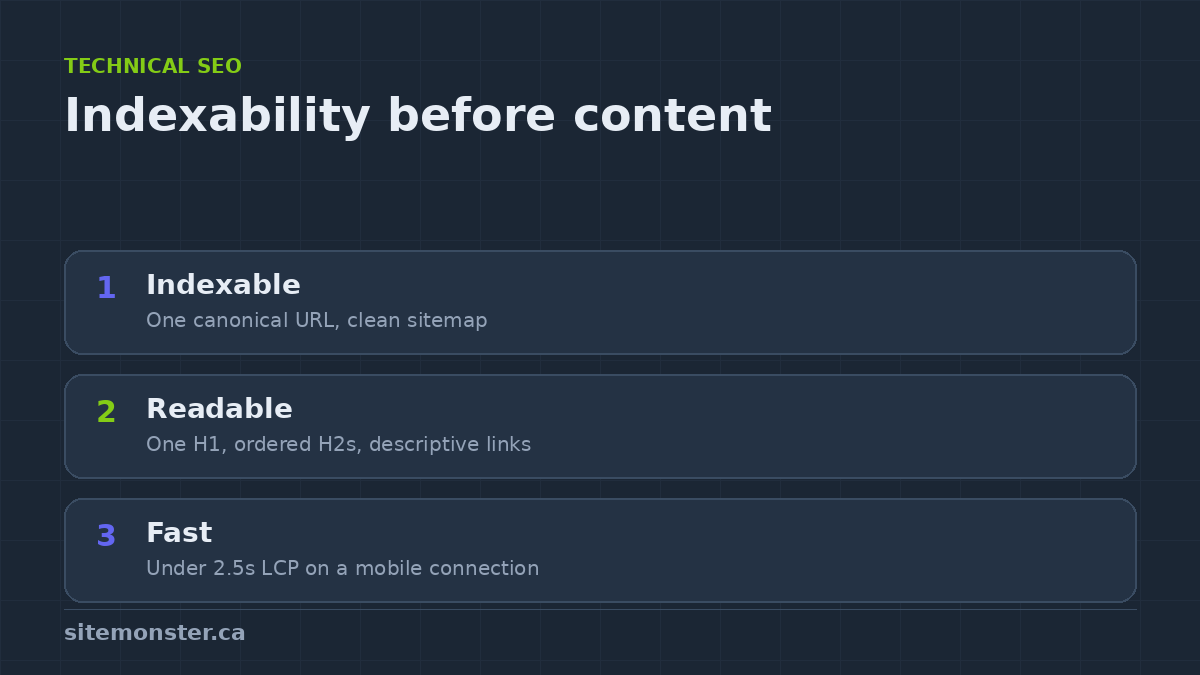
The order below matters because one fix often makes the next unnecessary. Indexability before content, content before schema, schema before speed tuning.
SEO friendly website design technical foundations
If any of these are wrong, nothing else on the page counts.
- One canonical URL per page, with a single H1 that states the page’s job
- A sitemap that lists only pages you want indexed, and noindex on login, portal and thank-you pages
- Clean, readable URLs that describe the page without dates or IDs
- Titles written by hand, under about 60 characters, with the keyphrase near the front
- Meta descriptions written as ad copy, not generated by a plugin from the first paragraph
SEO friendly website design: content that answers the query
Ranking starts with intent matching. A page targeting “web design cost Canada” has to show a price, not a philosophy of pricing. A page targeting “mobile friendly design” has to explain what to do, in order, with specifics.
Length is not the target; coverage is. A 600-word page that answers the question completely beats 2,000 words that circle it. Add depth where a buyer would still have questions, and stop when the questions run out.
On-page structure
These are the elements a crawler uses to understand the page.
- A heading hierarchy that reads like an outline: H2s for the main sections, H3s nested under them, no skipped levels
- Internal links from the page to the pages that should inherit its authority, with descriptive anchor text
- Schema markup that matches the page type: Service, FAQPage, Article, LocalBusiness or Product
- Image alt text that describes the image, not a keyword list
- A clear next action at the bottom of the page, because a page that converts is a page that earns links
What we check in SEO friendly website design before launch
The list is deliberately short. Every item on it has moved rankings for us.
For example, one H1 and a clean heading order make the page easier to read and easier to index. However, clean markup will not fix thin copy, so each service page needs its own written answer. Therefore the pre-launch list below covers structure, speed and content in that order.
| Check | Target | Why it matters |
|---|---|---|
| Server response | Under 200ms at the edge | Slow responses delay everything else |
| Largest content | Under 2.5 seconds on mobile | Directly scored in field data |
| Layout shift | Effectively zero | Shift hurts both UX and rankings |
| Heading count | One H1, ordered H2/H3 | Cheapest signal to get right |
| Internal links | Every page reachable in three clicks | Crawl depth limits discovery |
What we refuse to promise
Nobody can guarantee a position. Anyone who does is selling you a report you cannot verify. What a build can guarantee is that the structural work is done, the pages are indexable, the site is fast, and the content answers the query it targets.
After that, ranking depends on competition, links and time. Our free 48-hour audit shows you where the site stands against the pages currently holding the positions you want.
Get a structural SEO audit of your site
We check indexability, structure, schema and speed, then send back the fixes in priority order within 48 hours.